
LVP vs Carpet Tile for Offices and Healthcare Spaces in West Michigan
A practical comparison of luxury vinyl plank and commercial carpet tile for offices, clinics and medical buildings in Grand Rapids and West Michigan.
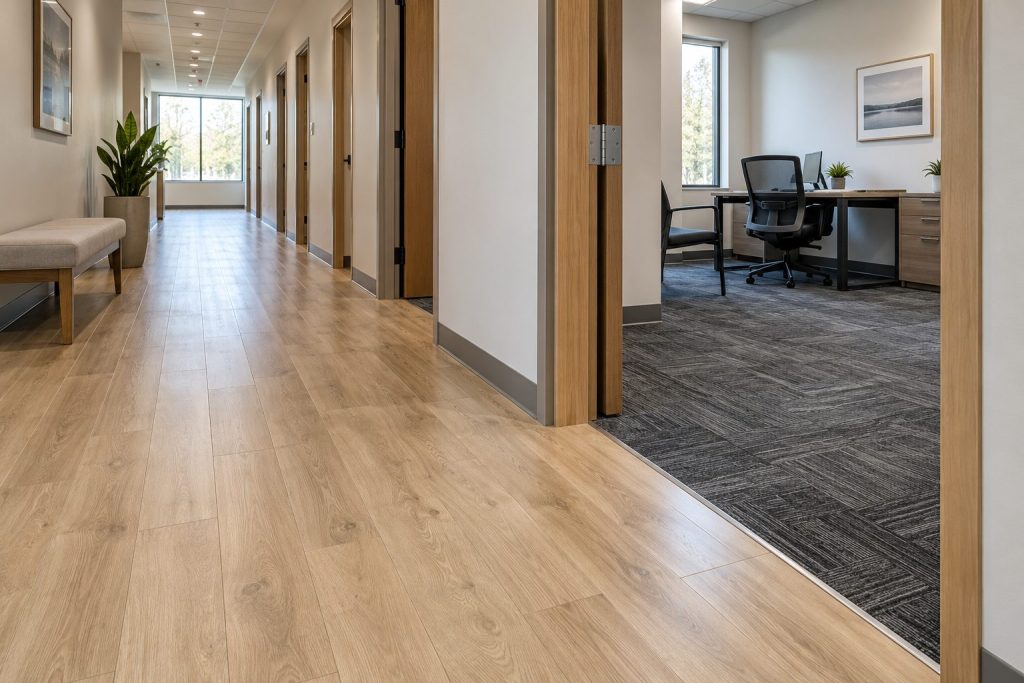
Luxury vinyl plank (LVP) generally outperforms soft coverings where a hard, scrubbable, low-moisture, nonporous surface is required for cleaning and infection control. Modular carpet tile performs best where sound control and underfoot comfort matter, and individual tiles can be lifted and replaced when contaminated without reworking the whole floor. The right setup often combines both across a building.
How do rolling chairs and carts affect each surface?
LVP typically performs better under rolling chairs and carts because it is a hard surface that resists permanent indentation and wear. Commercial carpet tile is designed for higher traffic than residential carpet and can accept casters, but pile height and backing matter for roll resistance. The Access Board notes that carpet pile over 1/2 inch can increase roll resistance and impede wheelchair maneuvering, so lower pile and firm backing are needed for accessibility and mobility compliance (Access Board guidance).
Which is better for infection control and cleaning in healthcare settings?
LVP is better suited to patient-care areas where scrubbable, nonporous surfaces are preferred. The CDC recommends scrubbable materials for patient-care areas and advises avoiding carpeting in high-traffic zones of patient-care areas or where spills are likely (CDC recommendations).
If you do use carpet tile, plan for routine vacuuming with well-maintained equipment designed to minimize dust dispersion, and replace tiles that are contaminated by blood or body fluids rather than attempting to clean them in place (CDC recommendations).
How do the two surfaces handle moisture and spills?
Hard plank LVP is far easier to dry and clean after spills and is less likely to retain moisture that could fuel mold growth, which makes it a safer choice around sinks and clinical equipment. The CDC warns that porous materials that become and remain wet can support mold growth and advises scrubbable materials in patient-care settings (CDC guidelines).
Carpet tile can be partially resilient to small spills if the tile backing resists wicking, but saturated tiles, pad or adhesive layers underneath can trap moisture. For healthcare areas where spills or bodily fluids are a realistic risk, plan to use hard surface flooring in immediate patient-care zones and keep carpet tile to areas where spills are unlikely.
What about acoustics and comfort underfoot?
For sound absorption and cushioned comfort underfoot in private offices, conference rooms and quiet work areas, carpet tile is usually the better choice because it reduces reverberation and masks footfall. It reduces reverberation and masks footfall noise better than LVP. LVP is harder and transmits more impact sound, but you can add underlayment to improve comfort and acoustics where budget and performance allow.
Which surface provides better slip resistance?
Both LVP and carpet tile can be specified for appropriate slip resistance, but you must check product crawl ratings and finish after installation. OSHA notes that static coefficient of friction is a reasonable measure of slip resistance, though there is no single numeric COF set as an OSHA standard (OSHA interpretation). In practice, choose hard surface finishes with textured surfaces for wet zones and carpet tile with low pile and firm backing for areas where traction and wheelchair access matter.
How easy is it to replace damaged sections?
Modular carpet tile remains the easiest to repair because individual tiles lift and replace without disturbing surrounding flooring, speeding repairs after wear, stains or localized damage. LVP can be repaired in sections but often requires careful removal of surrounding planks or cutting and reseating seams, which can be more labor intensive. For clinics, exam rooms and corridors where contamination or localized damage is likely, modular carpet tile or plank systems that allow partial removal reduce downtime.
What are the maintenance routines for each flooring type?
Maintaining LVP is straightforward: sweep and dust-mop daily in high-traffic zones, wet-clean periodically with an approved neutral cleaner, and perform heavier scrubbing as needed for soil removal; simple routines keep seams and finishes performing well over time. Carpet tile requires regular vacuuming with well-maintained equipment to reduce dust dispersion and periodic deep cleaning or extraction; in healthcare settings follow the CDC guidance to vacuum and replace contaminated tiles as needed (CDC recommendations).
What service life can I expect?
Service life depends on traffic, maintenance, subfloor condition and initial product quality. Both LVP and commercial carpet tile can last many years in commercial use when properly specified and maintained, but poor subfloor preparation, ongoing moisture problems or heavy unbraked cart traffic will shorten lifespan regardless of the surface chosen.
What drives the cost of installation?
Cost drivers are the same whether you choose LVP or carpet tile: subfloor prep, moisture testing, leveling, demo of old flooring and scheduling around operations. Subfloor problems add time because crews must grind, skim or install new underlayment to meet flatness and adherence requirements. Moisture testing is essential on slabs to avoid future failures. If the building must stay open, after-hours work or phased installation increases labor coordination. CFC-WM estimates bids around these factors rather than raw product cost, and we coordinate flooring and general contracting on one schedule to reduce handoffs.
Can buildings use both LVP and carpet tile?
Yes. Many buildings use both surfaces strategically to balance infection control, acoustics and durability. Typical patterns put LVP in corridors, exam rooms, break rooms and restrooms where cleanability and moisture resistance are priorities, and carpet tile in private offices, conference rooms and quiet areas where sound control and comfort matter. Transitions at doorways and thresholds should be detailed so they are smooth for mobility devices and easy to clean.
Start with a room-by-room map of likely traffic, equipment and spill risks. Note where carts, medication dispensing units and mobile equipment may roll, and designate those areas as candidates for hard surfaces. Test slabs for moisture and inspect subfloors for flatness before making a final selection.
Get samples on-site so staff can assess comfort and sound. Consider maintenance capacity: a building with in-house cleaning staff may manage carpet tile, while a clinic with contracted cleaning may prefer LVP for simpler disinfecting. Ask about expected wear for commercial traffic and about warranty terms that depend on proper installation.
How should I decide by room type?
Use the checklist below to match flooring to room function.
- Exam rooms and procedure areas: LVP or other hard, scrubbable surfaces for cleaning and infection control.
- Corridors and high-traffic circulation: LVP for durability and ease of maintenance.
- Restrooms and break rooms: LVP for moisture resistance and slip management.
- Private offices and reading rooms: Carpet tile for acoustics and comfort.
- Conference rooms and quiet work areas: Carpet tile for noise control and a softer feel.
- Storage, mechanical, and utility rooms: LVP or concrete finishes for durability and cleaning.
Who installs these flooring surfaces locally?
Construction & Facilities Consultants of West Michigan installs these flooring surfaces across Grand Rapids, Grandville and West Michigan, and our crews self-perform much of the work. CFC-WM schedules flooring and general contracting on one coordinated timeline and can phase work around clinic hours, nights and weekends so buildings can stay open during renovations.
What to expect when you call CFC-WM
We start with a site visit and moisture testing where applicable, inspect subfloors for flatness and remediation needs, and outline a phased plan if the facility must remain operational. We document any existing damage, include demolition and prep in the scope, and align crew schedules so flooring installation ties into other trades without repeated handoffs. Built. Fixed. Solved.
For facility managers, property owners and practice leaders in Grand Rapids, Grandville and the surrounding West Michigan communities, a short site review and free consultation will clarify which floors to use where and what the real installation drivers will be. Contact CFC-WM at our Grandville office to start the conversation.
Frequently asked questions
Is carpet tile acceptable in patient-care areas?
Carpet tile can be used in some patient-care areas, but scrubbable, nonporous surfaces are preferred and carpeting should be avoided in high-traffic or spill-prone patient zones according to CDC guidance.
What should I do if a carpet tile is contaminated with blood or body fluids?
If a carpet tile is contaminated by blood or body fluids, replace the contaminated tile rather than attempting to clean it in place, following CDC recommendations.
Do I need moisture testing before installing LVP on a concrete slab?
Yes, moisture testing is recommended before installing LVP on a concrete slab to identify conditions that require mitigation and to protect the new floor from failures.
Can LVP be repaired in a small area if damaged?
LVP can be repaired in localized areas but may require careful removal and reseating of adjacent planks, which can be more labor intensive than replacing individual carpet tiles.
Will carpet tile reduce noise in open office areas?
Yes, carpet tile reduces reverberation and footfall noise and is a good choice for private offices, conference rooms and quiet work areas where acoustics matter.
Can CFC-WM schedule flooring work around clinic hours?
Yes, CFC-WM can phase work around clinic hours and perform installations at nights and weekends so buildings remain open during renovations.
Sources
- Part II. Recommendations for Environmental Infection Control in Health-Care Facilities | Infection Control | CDC cdc.gov
- Guidelines for Environmental Infection Control in Health-Care Facilities (PDF) | CDC cdc.gov
- ADA Accessibility Standards | Access Board access-board.gov
- Static coefficients of friction for walking/working surfaces. | Occupational Safety and Health Administration osha.gov